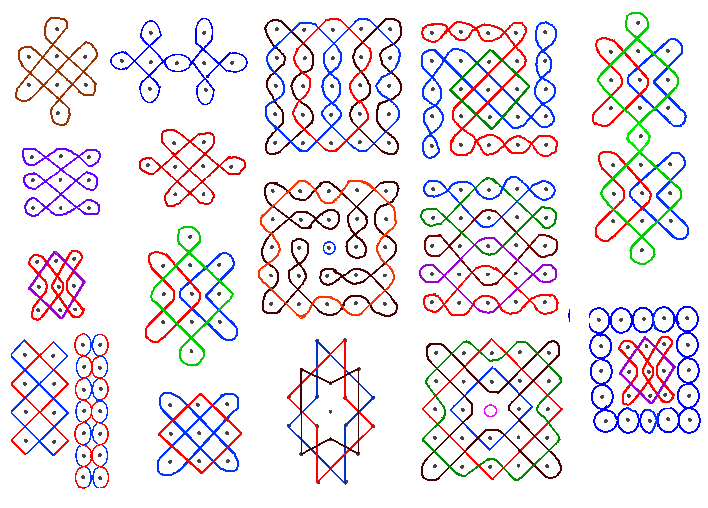
KOLAM is a sort of painted prayer , a line drawing composed of curved loops, drawn around a grid pattern of dots. Kolam which is originated from South India more than 3000 years ago. Women begin their day by drawing Kolam in front of their house . kolams are thought to bestow prosperity of homes.
In olden days , they used coarse rice flour for drawing kolam. It was drawn not just for decoration purpose , but it was to invite birds and other small creatures like ants , to eat it , so that they don't work hard for meal. It is a sign of invitation to welcome all into the house , atleast to Goddess Lakshmi , the Goddess of Prosperity. It is a mandate that the lines must be complete so as to symbolically prevent evil spirits from entering the inside of the shapes. And thus they are prevented from entering the inside of the house. Before drawing these artistic Kolam, they used to cleanse the place with a mixture of Cow dung and water, sprinkle it at the place where they used to put the Kolam drawings. This is in a way acted as an anti-bacterial agent. Though this practice is not continued in big towns and cities, one can see it in the remote villages and interior places.
In olden days , they used coarse rice flour for drawing kolam. It was drawn not just for decoration purpose , but it was to invite birds and other small creatures like ants , to eat it , so that they don't work hard for meal. It is a sign of invitation to welcome all into the house , atleast to Goddess Lakshmi , the Goddess of Prosperity. It is a mandate that the lines must be complete so as to symbolically prevent evil spirits from entering the inside of the shapes. And thus they are prevented from entering the inside of the house. Before drawing these artistic Kolam, they used to cleanse the place with a mixture of Cow dung and water, sprinkle it at the place where they used to put the Kolam drawings. This is in a way acted as an anti-bacterial agent. Though this practice is not continued in big towns and cities, one can see it in the remote villages and interior places.
Drawing Kolam also helps to improve mental discipline and concentration. It is belived that the "Dots" are symbolic of Challenges which we have to face in our lives and the "Curvy" ,line around these dots is the jouney (Yathra ),during our life.
Few Websites where you can find Kolam designs..:
http://www.kuzhalmannamagraharam.info/articles/kolam/kolam.1.a.gif
http://kolangal.kamalascorner.com/
Rangoli : The origin of rangoli painting is traced to a legend recorded in the Chitralakshana, the earliest Indian treatise on painting. When the son of a Kings high priest died, Brahma, Lord of the universe, asked the king to paint the likeness of the boy so that Brahma could breathe life into him again. This is how, it is believed, the first painting was made. Also, the son of the king painted a portrait of a girl whom the son liked very much, although the king would not let his son see her. Rangoli also became a form of self-portraiture for women.
Another popular story is that God, in one of his creative episodes, extracted the juice from one of the mango trees as paint, and drew the figure of a woman so beautiful that it put the heavenly maidens to shame.
They are known by different names in different parts of the country; Alpana in Bengal, Aripana in Bihar, Madana in Rajasthan, Rangoli in Gujarat, Karnataka and Maharashtra, Chowkpurana in Uttar Pradesh and Kolam in Kerala and Tamilnadu, Muggu in Andhrapradesh. Some of these, especially many of the North Indian ones like Aalpana more often refer to floor painting with traditional wet color, rather than the powder rangoli more conventional in south India.
Source : Wikipedia
http://kolangal.kamalascorner.com/
Rangoli : The origin of rangoli painting is traced to a legend recorded in the Chitralakshana, the earliest Indian treatise on painting. When the son of a Kings high priest died, Brahma, Lord of the universe, asked the king to paint the likeness of the boy so that Brahma could breathe life into him again. This is how, it is believed, the first painting was made. Also, the son of the king painted a portrait of a girl whom the son liked very much, although the king would not let his son see her. Rangoli also became a form of self-portraiture for women.
Another popular story is that God, in one of his creative episodes, extracted the juice from one of the mango trees as paint, and drew the figure of a woman so beautiful that it put the heavenly maidens to shame.
They are known by different names in different parts of the country; Alpana in Bengal, Aripana in Bihar, Madana in Rajasthan, Rangoli in Gujarat, Karnataka and Maharashtra, Chowkpurana in Uttar Pradesh and Kolam in Kerala and Tamilnadu, Muggu in Andhrapradesh. Some of these, especially many of the North Indian ones like Aalpana more often refer to floor painting with traditional wet color, rather than the powder rangoli more conventional in south India.
Source : Wikipedia
(Thanks to Manjula , who provided me the Ragoli photos)