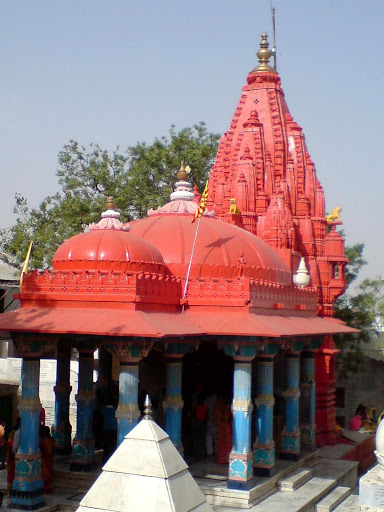
Showing posts with label Temples In India. Show all posts

Miracle in Kumbakonam - Shiva Temple


1265712287Cobra-doing-Sivapooja-during-Solar-Eclipse-1[1].pdf

check out this link for photos :

http://picasaweb.google.com/harshaanand18/Photo?authkey=Gv1sRgCMf57tav1-z03gE&feat=directlink

Large numbers of devotees witnessed a miracle of a Cobra doing Archana for Siva Lingam with Vilvam leaves. In Thanjavoor district of Tamil Nadu, near Thirunageswaram, there is a Siva Temple at Thepperumanallur. Here Vedhanthanayagi [Sakthi] with Viswanathaswamy [Siva] are the main Deities. In this Temple, it has been customary to do archana with Rudhraksha only. Yesterday morning, just before Solar Eclipse, at about 10:30 AM Sivachariar Satish, priest of the Temple,noticed a Cobra lying on top of the Siva Linga. The snake slowly descended from there and went towards the Vilvam tree which is the Sthala Viruksham- Holy tree of the temple. It climbed the tree and picked a Vilvam leaf and came back and entered the Sannadhi. It hissed at any devotee trying to get near it. It climbed onto the Siva Linga and opened it hood and dropped the Vilvam Leaf. This miracle was witnessed by all devotees who were excited. Then the Cobra went again and again to do the same repeated two or three times. As the news spread all over the village, hundreds of villagers rushed to the Temple to have the Dharshan of this event of Cobra with Siva.
The Priest explained "It is doing the archana during the Solar Eclipse time to wash off its sins".
[ Note: Vilvam leaf (Bilva Leaf) is holy and special for Siva Pooja]
News in Dinakaran - Dated: January 16, 2010

Kanchipuram

  • Location : 75-Km From Chennai, Tamil Nadu
  • Called : Religious Capital Of South India
  • Famous Temples In Kanchipuram : Kamakshi Amman Temple, Varadaraja Temple, Kailashanathar Temple, Ekambareshwar Temple, Kumara Kottam, Ulahalanda Perumal Temple
  • Important Festivals Celebrated : Brahmotsavam -Varadaraja Temple InMay; Garuda Sevai- Varadaraja TempleIn June; Float Festival -Varadaraja Temple In February And November; KamakshiAmmam Festival - February; Mahashivaratri Festival - Kailashanatha Temple In February; Panguni Uthiram -EkambareshwaraTemple In March-April.


Land Of Thousand Temples Kanchipuram is a small, rural town about 75-km from Chennai in the state of Tamil Nadu. With the Sankara Mutt acting as the hub of Hindu activities and the temples, Kanchipuram is one of the most highly visited pilgrimage spots in India, and can rightfully be called the "Religious Capital of South India". Kanchipuram was under the Pallavas from the 6th to 8th century AD and later became the citadel of the Cholas, Vijayanagar Kings, the Muslim and the British. It has been a center of Tamil learning, cultural and religious background for centuries. Kanchipuram has magnificent temples of unique architectural beauty bearing eloquent testimony to its glorious Dravidian heritage.All the religious cities in India support one of the two sects in Hinduism - Vaishnavism and Shaivism, but Kanchipuram has blended itself equally to both the sects, dividing itself into Vishnu Kanchi, surrounding the Varadaraja Temple, and Shiva Kanchi, surrounding the Ekambareshwar (also spelt as Ekambareshwa) Temple, while the Kamakshi Amman Temple stands in between as a place of Shakti worship.
Kailashanathar Temple :


Dedicated to Lord Shiva, Kailashanathar (also spelt as Kailashnatha) is one of the earliest temples built by the Pallava ruler Rajasimha Pallava and was completed by his son, Mahendra Varma Pallava in the 8th century AD. It is the oldest structure in Kanchipuram and the finest example of Pallava architecture in South India. The temple is situated among several low-roofed houses just over 1-km west of the town center. Of all the temples in India, no other edifice has been so elaborately filled with all the 64 aspects of Lord Shiva. The temple is unique in its architecture and is viewed more as an architectural wonder than as a holy place. Hence, it is never crowded with locals. But, once in a year during Shivaratri festival large crowds visit the temple and there could be hours of waiting in long queues.
Kamakshi Amman Temple :
India has three main cities where the Goddess Shakti is worshipped. Kanchipuram holds the most important rank among the three. In the same order, the three places are Kanchipuram, where the Goddess Kamakshi is worshipped, Madurai, where the Goddess Meenakshi is worshipped, and Kashi, where the deity is 'Visaalakshi'.The Kamakshi Amman temple is the hub of all religious activities in Kanchipuram. The temple is also in closer control of the Shankara Mutt, unlike the other temples, which are governed either by the Department of Archeology, Government of India, or the Hindu Temples Department of the Tamil Nadu Government. The kings of the Chola Empire built the temple in 14th century AD.The main tower over the sanctum (Vimanam) of the temple is gold plated. Also of significance is the Golden Chariot in this temple. The Golden Chariot is taken in a procession around the temple on Friday evenings around 7.00 p.m. This temple also features an Art Gallery with pictures depicting the history of Sri Adishankaracharya and the Shankara Mutt.
Kumara Kottam :
Kumara Kottam is located in between the Kamakshi and Ekambareshwar temples in the Somaskanda formation in the town of Kanchipuram. It is a well-visited temple with two Prakarams and a complete pantheon of Parivara Devatas enshrined in their respective shrines.In the sanctum, Muruga is in a seated pose. Valli, Deivayani are absent here, but their festival idols are kept here. In accordance with the function of Creation he has assumed, his right arm is in Abaya pose, the upper hand holds the rosary, and the lower left arm is on the thigh in Katyavailambita pose with the left arm holding the Kamandalam. The posture is also called "Brahma Chattam".Here only honey is used for ablutions. When one comes out after worshipping the main deity, one can see the festival idols. In the front part of the temple in the mirror room one can see the marble figure of Ramalinga Swamigal.
Varadaraja Temple :
The Varadaraja temple is one of the important shrines of Sri Vaishnavites, also known as "Hastigiri" and is one of the celebrated Vaishnava Divya Desams, located in Vishnu Kanchi or "the Little Kanchi". Originally it was known as "Attiyuran". The main deity here is Varadaraja Perumal in a standing posture facing west and the Lord here is also known as "Devaraja", "Pranatharthihara", "Deva Perumal", "Athiyooran" and "Perarulalan".Varadaraja temple with superb art has a magnificent history, which is associated with Sri Ramanuja, who used to serve here. Many miracles are said to have occurred. It was with his ministry that the temple, then already several centuries old, began to gain fame.
Ulahalanda Perumal Temple :
Ulahalanda Perumal temple, situated about half a kilometre from the centre of the town near Kamakshi Amman temple is one of the oldest temples in Kanchipuram. The deity Ulahalanda Perumal in this temple represents the "Vamana Roopam", an incarnation of Lord Vishnu taken to save the Devas from the Demon king Mahabali. The deity Ulahalanda Perumal is depicted by a huge image of about 35 feet high.
Festivals Celebrated In Kanchipuram :
Some of the important festivals celebrated in Kanchipuram are the Brahmotsavam -Varadaraja temple in May; Garuda Sevai- Varadaraja temple in June; Float festival -Varadaraja temple in February and November; Kamakshi Ammam Festival - February; Mahashivaratri festival - Kailashanatha temple in February; Panguni Uthiram -Ekambareshwara temple in March-April.
This posting was prepared by my friend Vidyo ..

Kukke Subramanya Temple


Kukke Subrahmanya is a Hindu temple located amidst hills of western ghats , small, rural village of Subramanya in the Sullia taluk of Karnataka, and is about 100 km. far from the Mangalore city. In the past the Subramanya used to be recognized as Kukke Pattana. This temple is one of the pristine pilgrimage locations in India. Here the God - Lord Subrahmanya is worshipped for his divine power as a divine serpent. The epics relate that the divine serpent Vasuki and other serpents found safety under Lord Subrahmanya when aprehended by Garuda.
Kukke Subrahmanya is situated on the banks of river Dhara, which originates in the Kumara Parvatha (mountain) and proceeds towards western sea. It is also called as 'Kumaradhara River'.The Subrahmanya temple is situated in the heart of this village.
According to Hindu Mythology :
Lord Kumaraswamy came to this place after killing the demon rulers Taraka, Shoorapadmasura and others in a war; and Lord washed his Shakti Ayudha (a battle-axe in the shape of a bayonet) in this river. From this onwards the river is famous as Kumaradhara. After his battle with the demons Lord Kumaraswamy came to the top of Kumara Parvatha along with his brothers Lord Ganesha, Veerabahu and other aides. He was received by Lord Indra along with other Gods; pleased by the success of the war Indra prayed the Lord to be kind enough to marry his daughter Devasena. This was agreed upon courteously and the marriage took place on the banks of Kumaradhara on 'Margashira Shudda Shashti'. Lord Kumaraswamy also gave darshan to Vasuki the head of nagas, who was making a penance here.Vasuki prayed to the Lord to stay along with him permanently at this place and the Lord granted him this boon. From that time it is believed that the Lord has made his spiritual presence in this shrine along with his wife Devasena and Vasuki.
Temple :
Pilgrims going to the Temple have to cross the Kumaradhara River, taking a holy bath in it before they go on to the temple to have darshan. The devotees enter the courtyard from behind and walk around to go before the idol. There is Garuda pillar covered with silver between the sanctuary and the portico entrance. It is believed that the pillar was charmed and planted there to shield the devotees from the poison flames streaming from the breath of Vasuki who resides inside. Devotees circle the pillar. Beyond the pillar is the outer hall and then the inner hall and after that the sanctuary of Sri Subrahmanya. In the center of sanctuary is a pedestal. On the upper dais stands the idol of Sri Subrahmanya and then the idol of Vasuki and somewhat lower the idol of Shesha. Devotions to these deities take place daily.
Legend of Subrahmanya swamy:
The Skanda purana narrates that Lord shiva was married to Dakshayini (also known as Sati), the daughter of Daksha. Daksha never liked Shiva and insults Shiva in front of Dakshayini in a Yagna. Unable to bear this insult, Sati immolated herself. Shiva unleashed his fury at the death of his wife by performing the Taandav Nrithya (a violent dance). He wiped out Daksha's kingdom, undertook penance and retired to the Himalayas.Tarakasura, the demon king believes that, since Shiva was an ascetic and his earlier marriage was itself conducted with great difficulty, his remarriage was out of the question, hence his boon of being killed by Shiva's son alone would give him invincibility.The same Sati was reborn in the house of Himalaya as Parvathi (daughter of parvatha) and performed a great penance to propitiate Shiva. But lord Shiva was in a rigorous penance and even the immaculate beauty of Parvathi cannot wake up Shiva from his penance. Devas devised a plan to wake up Shiva and approached Manmatha, the god of love to execute their plan. All gods arrived to the place where Shiva is performing penance, Parvathi too arrived.Manmatha awakened Shiva from his penance, incurring his wrath by opening his third eye of destruction, and being destroyed & resurrected. Lord Shiva married Parvathi, after Parvathi pleased Shiva by performing severe penance.Though divine being free from the cycle of birth, the newly wedded couple spent a thousand divine years in marital bliss, unaware of the desire of the gods. Then all gods sent the Agni (fire god) who appeared as a dove in the bed chamber of Lord Shiva. Realizing his reason Lord Shiva gave him a part of his energy. Finding the charge intolerable, Agni deva gave it in turn to Ganga who too felt its burning effects soon and she places it on a bamboo shrub. The nucleus thus placed, took a form of male baby (Gangeya) with six faces, thus the baby is called 'Shanmukha'. Shanmukha was first spotted and cared (by feeding him) by six women (Kruthikeyaru), thus Shamukha is called as Karthikeya. As he was born in forest (vana) on reeds (Shara), so he is also called as 'Sharavanabhava'. Lord Shiva and Parvathi takes Karthikeya to devaloka called him by the following names according to the incidents of his baby hood: Shanmuka, Agneya, Gangasuta (son of Ganga), Sharavanabhava, Karthikeya and Parvathinandana (son of Parvathi).Karthikeya was taught archery and Goddess Parvathi presented him with a weapon, thus Karthikeya also called as Velayudha. He was made as Devasenapati (lord of army of devas). Karthikeya destroys Tarakasura. As this youthful saviour he is called Kumara swamy.
Sarpa Samskara / Sarpa Dosha :
Sarpa Samskara/Sarpa Dosha is one of the poojas performed at this temple by devotees to get rid of the sarpa dosha (according to belief, a person either in this birth or any of his previous births can be afflicted by the sarpa (serpent) dosha (curse) either knowingly or un-knowingly through many ways). Persons who are afflicted with this dosha are advised by the astrologers /horoscope writers to perform this pooja for their well being. Pooja can be done either by the person afflicted if he is a male and married, or through a priest. This is because the pooja involves rituals similar to the ones done in performing shrartham (death rites). Sarpa Samskara seva devotees are required to stay for two days. The seva occurs in the day time with no particular poojas in the evening. Food arrangements will be provided to the said devotees by the temple devastanam, for four persons only per seva . Due to the wide belief in the snake god in the coastal regions of Karnataka and Kerala, this pooja is performed by people from all faiths.
Source : wikipedia & http://www.karnatakavision.com/kukke-subrahmanya-temple.php
(Thanks Padma for collecting points to this topic)

Pillayarpatti - Karpaga Vinayagar Temple


Karpaga Vinayagar koil is one of the oldest Cave Temples (Rock Cut) temples of Tamilnadu and situated at Pillayarpatti, which is between Pudukkottai and Karaikkudi. The town of Pillaiyarpatti is named after 'Pillayar' - the tamil name for Ganesha, and this ancient temple houses rock cut images of Shiva, Lingodbhavar and others as well as several other shrines. Steeped in the tradition of Agamic textsthe temple bears testimony to the vibrant temple culture of the Tamil people, passed down through centuries.Antiquity: Over 15 inscriptions are found within the temple, that help establish the age of the temple. The Sculptor who designed the figure of Load Vinayagar also had registered his signature as “ EKKATTOOR KONE PERUMPARANAN” ( Perunthatchan) is in Tamil letters which was in use between 400 BC and 500 BC. From this we can take for granted that is was carved just before 500 BC. From the history of divine architecture and from stone sculptures and from the available documentary evidence Pillaiyarpatti KARPAGAVINAYAGAR figure alone is the first Pillaiyar in the world.
Pillaiyar is the presiding deity here, and he is portrayed with two arms and a trunk curled towards his right in the valampuri mode. This 6 feet tall mammoth image of Ganesha is a bas relief in an excavated cave, off of a hill in the precincts of the temple. Scholars says that Lord Vinayaga is the Lord of wisdom, which is confirmed by the head of elephant in the shape of sacred mantram "OM".
Here Lord Vinayaga appears with 2 hands unlike in other places where he is seen with 4 hands. Karpaga Vinayagar is not having Mothakam (Sweet) at his right hand.He is in meditation ( having Lingam at his right hand ) for welfare of the entire Universe. Since he is Yoga Vinayagar (Vinayagar with Meditation and all fortunes) he grants all good thinks we request. Vinayagar’s trunk is curved at the right side ( Valampuri Vinayagar) which is also a unique feature. Lord Karpaga Vinayagar is seated facing northern side. In view of this those who pray to him get success after success. Also he is seen seated without Angusapasam, with his legs folded and stomach not touching the Asanam in the form of "Artha Padma" Asanam.The word Vinayaga means "Incomparable Leader" . Chanting of sacred mantrams by the student learning Vedas and agamas in the Vedaagama School create a divine atmosphere.
The deity of this temple is known as "Marudeeswarar" as Marudha tree (In Sansscrit Arjuna Virutcha,worship is followed in this temple which indicates that this temple in an ancient temple. The sculptur of pasupatheeswarar, "A cow worshipping Lord Siva by offering his milk" is the special feature of this temple. Also kubheran the Lord of wealth had worshipped at this temple.To illustrate the information that one where controls his five senses will be able to understand God, a sculplure of five headed snake wearing a Lingam on its neck is found here. The five head of the snake indicate the five senses while the Lingam indicates God. Also adding to the sprituality Goddess Laxmi, Saraswathi and Durgai are found together at the same sport.Unlike other places the three Lingams Thiruveesar, Marudheesar and Senchadeswarar and the three Goddess Sivagami amman, Vadamalar Mangaiamman and Soundara Nayaga amman all appear together at the same place and bless the devotees.It is believed that by worshipping Kathyayini amman at this temple women get relived from sevvai dosham which prevent them from getting married. "Sabda Madhar" whom importance due to changing time are provided with a seperate sannidhi known as Sakthi sannidhi at this temple.
Festivals:
The grandest of festivals is Ganesh Chaturti in the month of Aug - September, where a ten day celebration brings much gaiety to this temple town. Each day's celebration is marked by much splendor as Pillayar is taken in procession around town on several of his mounts, as are the other Pancha Murthys. The ninth day of the festival is marked by a chariot procession. In addition, the ten day festival in the month of Vaikasi (May - June) is held in honor of Kongu Nachiyamman, a village deity whose processional image is also housed here. The Margazhi Tiruvadirai festival is celebrated in honor of Nataraja and Sivakami (Dec - Jan).
Devotees who observe Chathurthi Fast for a year come to Pillaiyarpatti on Avani Sukkilaptcha Chathurthi day (Festival) and fulfills it. They observe fast on Chathurthi day in front of vinayagar sannaidhi and take part in “ KumnaJebam” and receive holy pot of chanted holywater and take bath taking for granted that they bathe Loard Vinayagar seated in their hearts. Observing of Vinayagar Chathurthi Fast for one full year brings all blessings and wealth to devotees and it is also a proved fact.
"VINAYAGAR CHATURTHI" , The festival will begin with Kappukattu and flag hoisting on the first day, cultural programs are conducted from 6th day onwards. During the day and night, Lord Vinayaga is taken around in procession through the streets where he is seated in different vahanams every day.
1st day - Silver Muueshika Vahanam
2nd day - Simma Vahanam
3rd day - Boodha Vahanam
4th day - Kamala Vahanam
5th day - Siver Rcishaba Vahanam
6th day - Silver Elephant Vahanam upto Kagamugasura Samkaram and then in Golden Bandicoot Vahanam
7th day - Silver Peacock Vahanam
8th day - Horse Vahanam
9th day - Elephant Vahanam
10th day - Theerthavari will be celebrated in the morning during night the Procession of five Lords seated in silver and golden Vahanam will take place.

Retrieved from "http://en.wikipedia.org/wiki/Karpaka_Vinayakar_Temple"

SHIVAGANGE TEMPLE - YOUTUBE VIDEOS.


Part 2 :


Part 3 :


Part 4 :


Part 5 :


Shivaganga is only 70 km from the Garden city of Bangalore. Shivaganga in Karnataka is located in the hill top which is about 1368 meters high and lies on the national highway number 4.

The small town of Shivaganga in Karnataka is situated on the four-faced hill. The eastern part resembles the Nandi bull of Lord Shiva, the western part resembles Ganesha, the southern part resembles a linga and finally the northern part resembles King Cobra. Shivaganga in Karnataka is the home to two main shrines, Gavi Gangadhareshwara Cave Temple and Honnadevi Temple. You will be amazed to see the beautiful natural spring at Patalaganga on your way to the hilltop of Shivaganga.

The temple of Lord Shiva and waters found is said to be from river Ganga which was believed to be from holy waters of Ganga in Kashi. Shivaganga has a temple on the hill top where you will find a statue of Nandi. Thousands of devotees come to the temple of Shivaganga at Karnataka to pay their homage to the Lord.

The landscape of Shivaganga is very enchanting and you will have a panoramic view of the down town from the height of 1368 meters. There is a quadrangular Shivaganga Fort, located in the south western part of the old city of Shivaganga. The fort was built by the nayaka ruler, Sevappa Nayaka in the 16th century. The fort comprises of a square Shivaganga tank, Brihadishvara temple, Schwartz Church and public amusement park.
Thousands of devotee come to Shivaganga of Karnataka to take a holy dip in the tirtha or sacred water place and see the 100 pillars hall in Shivaganga.

There are two main temples at Shivaganga--Gavi Gangadhareshwara Cave Temple and Honnadevi Temple.The followers need to climb a number of stairs to arrive at the temples. The Patalaganga is situated between the two temples.

This is a natural spring. The travelers can take rest at this monolithic rock while climbing the huge stairs.

This ancient town houses old temples and it is probably for this reason that it is often referred to as Dakshin Kashi or Varanasi of Southern India. Shivaganga in Karnataka lies in the Tumkur district. The nearest railway station is 12 kilometers away. This religious site is also accessible by
road from Bangalore.

Source : www.youtube.com

Shivagange Temple

This is a hill which looks like the shape of the Shiva Linga from one of its sides. There are spring water spots found on this hill, it is believed that the water is “Gange” sacred river for Hindus. Located just about 60kms from Bangalore, near Dobbspet, Tumkur district this hill is ideal location for a one day trek. Also it is a holy place which is known as “Dakshina Kashi”. Here on the hills are several temples – Gangadhareshwara temple, Olakal Teertha, Nandi Statue, Patalagange.

Gangadhareshwara Temple :
As we go up the hill, we first see the Gangadhareshwara, ancient temple, dedicated to Lord Shiva. It has a low roof and alight only with diyas. Pujas and abhisheka are performed here. It is believed that the Abhisheka in ghee turns into butter. There is a tunnel in the Garba Griha (inner sanctum) which is believed to be connecting to the Gavi Gangadhareshwara temple at Bangalore. Nobody has tried to enter the tunnel as it is closed from both the entrances for safety reasons.
There many sculptures and carving on the walls and the pillars. But most of them have succumbed to weather and neglect; some have lost their heritage look after being painted.

Olakala Teertha :
Further up on the hillock we come across the spring water, Olakala Teertha. One has to step down the narrow stairs between the rocks to find the spring. It is said that one who is pious and good can touch or feel the water.


Nandi Statue :
At the top of the hill is the Nandi Statue, is a monolith placed on a huge rock .The view around the area atop the hill is mesmerizing. This is the peak of Shivagange. After this is the visit to Patala Gange.

Patala Gange :
Patala Gange is a temple built in the mountain. Here it has underground spring seeping at entrance of the temple. Sometimes the water level is up to the knee length and very cold. Passing this we arrive at the Garba Griha where in we can crawl into a tunnel to make the Pradakshina to the Lord. They say the water flows here is connected at Antargange.

To view the photos of the temple check this link :
http://karthikr.wordpress.com/2005/03/13/shiva-ganga/


Source : http://www.karnataka.com/
(I came to know about this temple , from Padma.)

Lord Brahma Temples

Brahma Temple is located near the Lake at Pushkar in Rajasthan, Brahma Temple receives many pilgrims to its doorsteps every year. Built in the 14th century, Raised on a high platform, the temple lies in the Pushkar valley that is known for its scenic beauty. Brahma Temple commemorates Lord Brahma, who is considered as the creator of this Universe . For the Hindus, Brahma Temple is an important pilgrim place. since all the Gods & Goddesses of Hindu pantheon observed a 'Yajna' here. Moreover, the Pushkar Lake near this temple is believed to have been appeared when a Lotus flower fell from the hands of Lord Brahma in this valley.
According to the Hindu mythology, once Lord Brahma was cursed that he would be not worshipped frequently by the people. Due to the reason, this is the only known temple in the world, where Lord Brahma is the main deity. Constructed entirely in marble, the Temple can be easily identified with its tall red spire. The temple is accessible by a flight of marble steps. An image of 'Hans' (Goose) can be traced on the entrance of the main shrine. One can also spot the silver turtle, which is embossed on the floor in front of the sanctorum. In the vicinity of the turtle, many a silver coins are placed on the floor. Even, the inner walls of the temple are studded with silver coins. The main shrine houses the life-size image of Lord Brahma with four hands and four faces, facing the four basic directions. An image of Goddess Gayatri, who is known as the milk Goddess, can be seen near the idol of Lord Brahma. The walls of the temple are adorned by beautiful images of Peacock and Goddess Saraswati.
From the temple, there is a silver door that leads down to a small cave. This small cave comprises a temple of Lord Shiva.
Though most people know of only one Pushkar, there are in fact three Pushkars. All of them are in Ajmer. It is believed that while the lotus bloom itself landed in the Pushkar Lake, the two other leaves that came with the stem of the lotus fell at two other lakes. One of them is called Bhuda Pushkar and the other one is called Madhya Pushkar. Villagers who live around Bhuda Pushkar and Madhya Pushkar believe that those are the real Pushkars.
Pushkar is known as teerthraj or king of all pilgrimages. It is believed that Lord Brahma pooled water from Badrinath, Jagnnath, Rameshwaram and Dwarka to create Pushkar Lake. That is why Pushkar lake is called the teerthraj.
Since Pushkar is the place where the first sacrificial offering was made by Lord Brahma and since the water in Pushkar Lake represents combination water from four important pilgrimages for the Hindus, it is considered to be as holy as the water from river ganges. It follows, therefore, that if you take a holy dip at teerthraj Pushkar Lake, you automatically become eligible for gathering the boons for visiting the other four pilgrimages.
There are also temples in
  • Asotra village in Balotra Taluka of Barmer district in Rajasthan known as Kheteshwar Brahmadham Tirtha,
  • Goa, (in the small, remote village of Carambolim in the Sattari taluka in the northeast region of the state);
  • in the temple town of Kumbakonam, (Thanjavur District) in Tamil Nadu;
  • and in Thirunavaya in Kerala. Regular pujas are held for Brahma and during Navrathris, this temple comes to life with colourful festivities.
  • There is also a shrine for Brahma within the Bramhapureeshwarar temple in Thirupattur, near Trichy
  • and a famous murti of Brahmā at Mangalwedha, 52 km from Solapur district in Maharashtra,
  • the largest of which is in Angkor Wat in Cambodia.
  • In Khedbrahma, Gujarat, there is a statue of Brahma.A six feet tall statue was also discovered at Sopara near Mumbai.
  • There is a temple dedicated to Lord Brahma in the temple town of Sri Kalahasti near Tirupati in Andhra Pradesh
The Following are the links for the Pushkar temple Photos :
  1. http://lh4.ggpht.com/_qajcSH5aCfc/Rs7Qy0di2NI/AAAAAAAAAOU/3C-qRJcvARE/Brahma+Temple.JPG
  2. http://images.google.co.in/imgres?imgurl=http://farm2.static.flickr.com/1361/1236621243_cdc9865c43.jpg%3Fv%3D0&imgrefurl=http://www.flickr.com/photos/hgmphotos/1236621243/in/set-72157601611191753/&usg=__ADvo2hMTFTRzQeudcioHlrHTW80=&h=500&w=367&sz=149&hl=en&start=29&um=1&tbnid=3_cG5agD6w2bDM:&tbnh=130&tbnw=95&prev=/images%3Fq%3Dlord%2Bbrahma%2Btemple%2Bimages%26start%3D20%26ndsp%3D20%26um%3D1%26hl%3Den%26sa%3DN
  3. http://lh4.ggpht.com/_DzQLAEpBrfM/R1FMZ52fGWI/AAAAAAAACYA/hnniPwMX8_I/India+-+Rajasthan+-+Pushkar+19.jpg

Chidambaram Natarajar Temple - PART 2

To read part 1 , check this link : 
http://hindutradition.blogspot.com/2009/01/chidambaram-nataraja-temple.html


The Legend of Chidambaram and its Significance :

The story begins with the legend of Lord Shiva strolling into Thillai vanam. In the Thillai Vanam resided a group of saints who belived in the supermacy of Magic and that God can be controlled by rituals and 'Mantras' or 'Magical words'.The Lord strolls in the forest assuming the form of Pitchanadaar (a nude mendicant seeking alms.) He is followed by his Consort. The rishi wives were enchanted by the brilliance and the beauty of the handsome mendicant and his consort.
On seeing their womenfolk enchanted, the rishis get enraged and invokes scores of serpents by performing magical rituals. The lord as the mendicant, lifts the serpents and dons them as ornaments on his neck and waist. Further enraged, the rishis invoke a fierce tiger, which the Lord skins and dons as a garment around his waist.
Thoroughly frustrated, the rishis gather all their spiritual strength and invoke a powerful demon Muyalakan. The Lord gently simles and steps on the demon's back, immobilizes him and performs the Ananda Thandava(the dance of eternal bliss)and discloses his true form.The rishis surrender, realizing that this Lord is beyond magic and rituals.

Other shrines in temple :

Apart from the five sabhais are :
  • The shrines for the original Shivalinga worshipped by saints Patanjali and Vyagrapadha, called the Thirumoolattaneswarar and his consort Umaiyammai / Umaiya parvathi.
  • The Shrines for the (63) Arubathu Moovar prime devotees of Lord shiva
  • The shrines for Goddess Sivagami
  • The shrines if Lord Ganesha
  • The shrines of Lord Muruga
  • There are also other small shrines in the temple complex.
The Chidambara Ragasiyam :

The Lord Shiva in his manifestation of formlessness is worshipped in Chidambaram. The Lord is said to continuously dance in a state of eternal bliss "Ananda Thandavam", with his consort Goddess Shivagami and is driagammatically represented by a Yantra on the wall of an empty space in the sanctum sanctorum of the temple. A curtain cover this space which when drawn reveals strands of golden Vilva leaves hung to indicate the Lord's presence.The curtain is dark in the exterior, indicating ignorance and brighter red in colour in the interior indicating wisdom and bliss.During the Daily rituals, the chief Priest of the day, himself in a state of godliness- Shivohambhava, withdraws the curtain indicating the withdrawal of ignorance and reveals the space, and the Lord's presence.
Thus, in total surrender, one lets God intervene and remove ignorance, one gets to see and experience his presence and hence bliss.

The Temple's Daily Rituals : The day begins with the chief priest of the day, performing requeried rituals to purify himself and assume the shivohambhava,after which he enters the temple to do the daily rituals of the temple.
The Day commence with the Lord's Padukas (footwear) being brought at 7.00AM from the Palliyarai to the sanctum sanctorum in a palanquin accompanied by devotees with cymbals and chimes and drums. The priest then performs a Yagna. Pooja is done 6 times a day. Before each pooja , the spatika Linga is ointed with Ghee, Milk, Curds, Rice, Sandal paste and Holy ash. This is followed by presenting the neivedhyam to the lord and the deeparaadhana, reciting of Vedas in sanskrit and the Panchapuranam. The Pooja ends with the priest parting the curtain in the sanctum sanctorum to reveal the chidambaram ragasiyam.
Before the Second pooja, apart from regular anointing the Crystal linga, a the Rathinasabhapathy(Ruby Nataraja Deity ) is also ointed.
The Third Pooja is at around 12.00 Noon, after which the temple closes and again opens at around 4.30PM.
The Fourth Pooja is performed at 6.00PM. then the fifth and the sixth pooja are performed at 8.00PM. and 10.00PM. respectively, after which the Lord's Padhukas are taken in a procession for the God to retire for the night.
To Conclude, chidambaram is also been called as Thillai vanam, perumpatrapuliyur or Vyagrapuram. The temple is located at the Lotus heart of the Universe.

Chidambaram Natarajar Temple - Part 1

Before starting to write about Chidambaram Natarajar Temple ,I wanted to convey that, my friend Vidyolatha passed on this information. I have just added few more points.

Chidambaram Temple is a famous temple dedicated to Lord Shiva located in the heart of the temple town of Chidambaram, 58 Km. south of Pondicherry in Cudalore District, the east - central part of the Tamil Nadu . This temple surpasses (Distinguish oneself) the limits of architectural wonders.
In Hindu literature, Chidambaram is the seat of the cosmic dancer Nataraja (Ananda Tandava pose ; the Cosmic Dance of bliss(A state of extreme happiness)). one of the five holiest Shiva temples, each representing one of the Five Natural Elements , (the Pancha Bhutasthalas).
  • Chidambaram is the Aakasha sthalam - Space.
  • Kanchipuram is the Prithvi sthalam - Earth,
  • Tiruvanaikaval is the Appu sthalam - Water,
  • Kalahasti is the Vaayu sthalam - Air &
  • Tiruvannamalai is the Thejo sthalam - Fire.
Temple dedicated to Lord Shiva and Lord Govindaraja Perumal, one of the few temples where both the Shaivite and Vaishnavite deities are enshrined in one place.
Temple Architecture and Significance : This temple is spread over 40 acres in the heart of the city.
It is surrounded by massive walls with four big tall gopurams in four directions and a big tank called Sivagangai tank measuring 175x100 feet towards the North. The North & South gopurams are 160feet high. The 108 dance postures as seen in the Natya Sastra are sculpted in these towers. It has five principal sabhais known as Kanakasabhai, Chit sabhai, Nritya sabhai, Deva sabhai and Raja sabhai.


Roof of the Chitsabha Mandapam :
1.The Chit Sabhai , which is the sanctum Sanctorum housing Lord Nataraja, his consort Goddess Shivagamasundari.The idol of Nataraja is enshrined in the Chit sabhai. Behind this idol, is a screen, which is considered to cover the Akasa Lingam. It is an invisible Lingam, with golden vilva garlands, i.e stressing the belief that there is everything in nothing. There are five silver plated steps to reach the Chit Sabhai, representing the Panchakshara mantram - Na ma si va ya. The embossed images of the saints Vyagrapada and Patanjali, are to be seen on the doors. Both these saints had been blessed witht the sight of the cosmic dance of Shiva. Lord Vishnu also is said to have witnessed this scene.

The images of Ratnasabhapati (Nataraja of Ruby), the Spatika Lingam of Chandramauleeswara, Swarnakarshana Bhairavar, Mukhalingam are also to be found in the Chitsabhai.

2. In the Kanaka Sabhai (golden hall) lying adjacent to the Chit Sabhai, poojas are offered. The ceiling of these two sabhais are gold plated.
3.The Nritya Sabhai, which is richly sculpted in the form of a chariot drawn by horses houses the images of Nataraja in Urdhava Tandava pose, image of Sarabheswara. In this sabhai the Lord is said to have danced with goddess kali, an embodiment energy and established His supermacy.

4. The Deva Sabha is a spacious hall meant for the celebration of important festivals and houses the festival images of the Pancha Murtis (Somaskandar, Parvati, Vinayaka, Subramanya and Chandikeswara) and other deities.

5.The Raja Sabha measuring 103 metres by 58 metres is housed in a 1000 pillared hall in the outermost prakaram. Tradition holds that Sekhizhar did here the arangetram (first recital) of Peria Puranam that details the history of 63 Nayanmars

To be continued in Part - 2 . : check this link:

hindutradition.blogspot.com/2009/01/chidambaram-natarajar-temple-part-2.html
Related Posts Plugin for WordPress, Blogger...